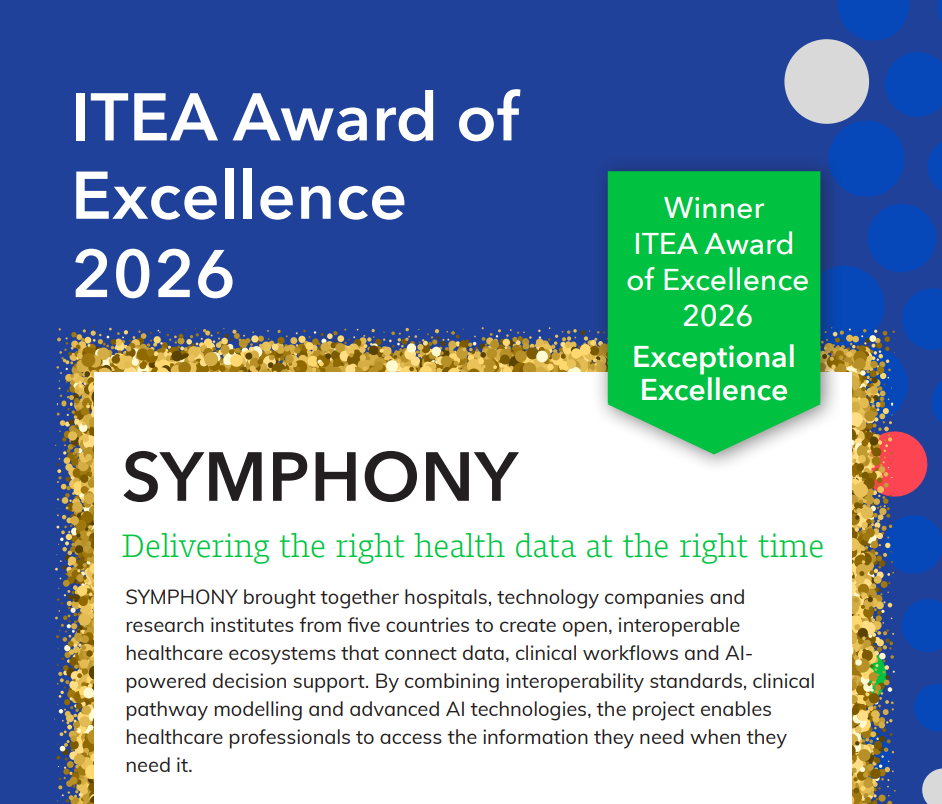
SYMPHONY has received the 2026 ITEA Award of Excellence in the “Exceptional Excellence” category, in recognition of its outstanding contribution to improving healthcare through artificial intelligence, interoperability and international collaboration.
The award ceremony will take place on 15 September 2026 in Istanbul, Türkiye, where the most outstanding results of ITEA projects were recognised.
An open and interoperable healthcare ecosystem
SYMPHONY (Eco-system for disease-specific clinical workflow and data integration) addressed one of the most common challenges in healthcare systems: the fragmentation of clinical information. Patient data is often scattered across different systems, departments and organisations, making decision-making more difficult, increasing administrative burden and limiting the effective use of available data.
To tackle this challenge, the consortium brought together hospitals, technology companies and research institutes from five countries (Canada, the Netherlands, Spain, Sweden and Türkiye) to create open, interoperable healthcare ecosystems that connect data, clinical workflows and AI-powered decision-support tools.
The project focused on four complex clinical domains:
-
Prostate cancer.
-
Aortic aneurysm.
-
Atrial fibrillation.
-
Multiple sclerosis.
Overall, the consortium developed 44 algorithms, models and clinical decision-support tools, significantly exceeding the project’s initial targets. These innovations enable care teams to access an integrated view of the patient, automated risk assessments and improved support for multidisciplinary care.
Impact visible from the outset
SYMPHONY’s results are already generating impact in real-world settings. At Karolinska University Hospital in Sweden, digital workflows developed within the project have replaced paper-based reporting in prostate cancer care, reducing administrative burden and ensuring that patient information is available throughout the care pathway.
In multiple sclerosis and aortic aneurysm care, SYMPHONY demonstrators have shown how the integration of data and AI solutions can provide clinical teams with a comprehensive view of the patient’s condition and support better-informed, more coordinated treatment decisions. Similar capabilities have also been demonstrated for atrial fibrillation, strengthening confidence in their future clinical use.
In addition, several project innovations are progressing towards commercial deployment. Philips has obtained FDA clearance and CE marking for vascular imaging functionalities developed within SYMPHONY, which are already being integrated into routine clinical workflows.
An open framework for clinical AI
Beyond specific solutions, one of SYMPHONY’s most significant achievements has been the creation of an open, vendor-neutral framework that enables healthcare organisations to integrate data, applications and AI solutions in a standardised way.
This framework can serve as a blueprint for interoperable digital care platforms, helping hospitals connect existing systems, adopt new applications and provide clinicians with a more complete view of their patients.
To facilitate the reuse of these results, the consortium has published a public white paper: “Building the Foundations for Standardized Clinical AI: The SYMPHONY Contributions”. The document explains, in practical terms, how to combine existing standards — HL7 FHIR, openEHR, DICOM and IHE profiles — into a coherent, vendor-neutral architecture, and captures the lessons learned across the four clinical use cases. Instead of creating new standards, SYMPHONY demonstrates how to make the ones already available work together, offering a reusable reference for other projects and organisations.
The public white paper will remain an open reference for building interoperable clinical AI platforms.
Spanish participation and next steps
Our contribution to this project has been the development of CareMe, a telemedicine platform that strengthens communication between patients and healthcare professionals and integrates with solutions from other partners such as SOPHEON, INNOVA and Intellecsia. CareMe forms part of the broader ecosystem enabled by SYMPHONY and is available in Spain via the Google Play and Apple Store. In addition, new features and tools building on CareMe and oriented to people living with multiple sclerosis are currently being explored.
Looking ahead, the consortium plans:
-
The deployment of all use case solutions.
-
The commercial rollout of innovations derived from the project, including products with FDA clearance and CE marking.
-
Expansion to new AI-enabled workflows by reusing the project’s architecture.
-
Continued leadership in healthcare standards through openEHR, FHIR, DICOM and IHE.
Recognising excellence in healthcare innovation
The 2026 ITEA Award of Excellence recognises the project’s ability to move from validated prototypes to solutions with real-world impact, progressing towards deployment, wider adoption and standardisation.
Key highlights of the project include:
The development of 4 end-to-end clinical ecosystems on open, reusable platforms.
Deployment in production environments, with FDA-cleared and CE-marked solutions.
The delivery of 5 models, 16 algorithms and 23 tools, far exceeding initial project targets.
Improved interoperability by combining existing standards (IHE, DICOM, FHIR, openEHR) rather than inventing new ones.
The project, which ran from October 2022 to March 2026, received funding under the ITEA programme, the Eureka Cluster on software innovation.